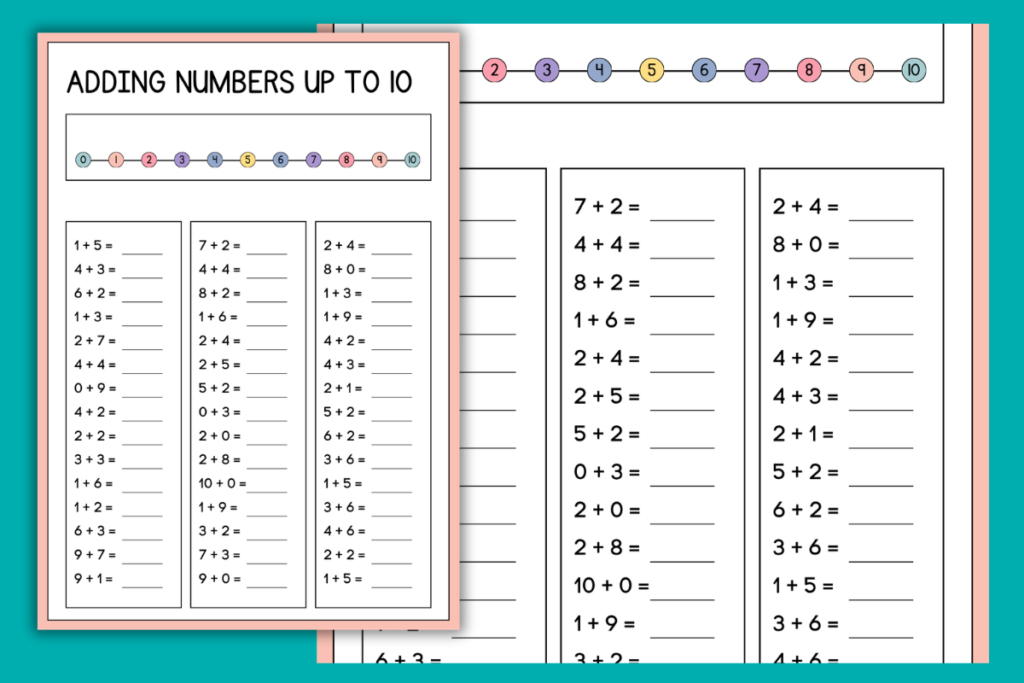
One of the most significant milestones in a child’s early education is the transition from simply counting objects to understanding the concept of addition. Our resource, “Adding Numbers Up to 10 worksheet” is specifically designed to support children aged 5–7 as they navigate the foundations of maths.
In this guide and activity pack, we simplify the process of combining sets, helping young learners gain confidence with numbers. Whether you are a teacher looking for a classroom supplement or a parent supporting home learning, this resource provides the perfect stepping stone into the world of KS1 Maths Resources.
What is Adding Numbers Up to 10?
At its simplest level, adding numbers up to 10 is the process of bringing two or more groups of items together to find a new total. For a child in Year 1 or Year 2, this is often their first introduction to formal mathematical operations. It moves them away from rote counting (1, 2, 3…) and towards operational thinking.
In “Adding Numbers Up to 10 – Easy Counting Math for Kids,” we focus on “within 10” because these are the essential building blocks for all future mathematics. If a child can fluently add numbers to 10, they can eventually add to 100, 1,000, and beyond. We explain this to children as a way of “joining” groups. For example, if you have three red apples and two green apples, how many apples do you have altogether? By using relatable, real-world examples, we make the abstract concept of addition feel tangible and exciting.
What Children Will Learn from This Resource
Our resource is structured to provide a multi-sensory learning experience. By using “Adding Numbers Up to 10 – Easy Counting Math for Kids,” children will develop a variety of key skills, including:
- Understanding Mathematical Symbols: Children will learn to recognise and use the plus (+) and equals (=) signs correctly.
- Counting On: Instead of starting from one every time, we teach children to hold the larger number in their head and “count on” the smaller number.
- Number Bonds to 10: Pupils will begin to memorise pairs of numbers that make 10 (e.g., 7+3, 6+4), which is a vital skill for mental maths.
- Visual Representation: The resource uses “part-whole” models and ten-frames to help children see how numbers are composed.
- Zero as a Value: Learners will understand that adding zero to a number leaves the total unchanged—a concept that can sometimes be tricky for early learners.
If your child is still working on basic number recognition before starting addition, you might find our EYFS Activities helpful for building that initial familiarity with digits.
How to Use This Resource in Lessons or at Home
“Adding Numbers Up to 10 – Easy Counting Math for Kids” is versatile and can be adapted for various settings. Here are a few ways to get the most out of it:
In the Classroom
Teachers can use these materials as a “starter” activity to wake up the brain at the beginning of a maths lesson. The worksheets are excellent for independent study time or as part of a “maths carousel” where children rotate through different stations. Because the resource is visually driven, it is also perfect for supporting EAL (English as an Additional Language) students who may understand the mathematical concepts but are still learning the terminology.
At Home
For parents, this resource is a fantastic way to reinforce what is being taught in school. We recommend using physical objects—often called “manipulatives”—alongside the worksheets. Use pasta shapes, buttons, or toy cars to mirror the problems on the page. Ask your child to “show” you the addition before they write the answer. This creates a bridge between the physical world and written symbols.
Educational Benefits for Children’s Development
Mastering “Adding Numbers Up to 10 – Easy Counting Math for Kids” offers benefits that extend far beyond the maths classroom.
- Cognitive Development: Addition requires logical reasoning. Children must understand the relationship between parts and a whole, which strengthens their problem-solving abilities.
- Confidence Building: There is a great sense of achievement when a child solves a sum correctly. This builds a “can-do” attitude toward STEM subjects early on.
- Fine Motor Skills: Writing numbers and drawing symbols helps develop the hand-eye coordination required for neat handwriting.
- Foundation for Subtraction: Once a child understands that 4 + 2 = 6, they are much closer to understanding the inverse relationship: that 6 – 2 = 4.
For more resources that help develop these core skills, check out our full range of Primary Education Resources.
Aligned with the UK National Curriculum
We understand how important it is for educational materials to align with the standards set by the Department for Education. “Adding Numbers Up to 10 – Easy Counting Math for Kids” is strictly aligned with the Key Stage 1 (KS1) National Curriculum for Mathematics.
Specifically, it addresses the following Year 1 objectives:
- Number – Addition and Subtraction: Read, write, and interpret mathematical statements involving addition (+), subtraction (–), and equals (=) signs.
- Represent and Use Number Bonds: Represent and use number bonds and related subtraction facts within 20 (starting with the foundation of 10).
- Solve One-Step Problems: Solve one-step problems that involve addition and subtraction, using concrete objects and pictorial representations.
By using this resource, you can be confident that you are providing high-quality instruction that prepares children for the Key Stage 1 SATs and their future journey into Year 2 and beyond.

Top Tips for Teaching Addition
To make the most of “Adding Numbers Up to 10,” keep these tips in mind:
- Use a Number Line: Encourage children to use a number line to hop from one number to the next. This helps them understand the order and magnitude of numbers.
- Focus on Vocabulary: Use different words for addition, such as “plus,” “total,” “sum,” “altogether,” and “more.” This enriches their mathematical vocabulary.
- Make it a Game: Turn addition into a challenge. “I have 4 grapes, if you give me 3 more, how many will I have?” Learning through play is often the most effective method for this age group.
Addition is the gateway to the rest of mathematics. By mastering these easy counting skills now, children set themselves up for a lifetime of numerical literacy. If you are looking for further challenges once your child has mastered these basics, explore our Year 2 Maths Activities to keep the momentum going.
Ready to start counting?
Download “Adding Numbers Up to 10 – Easy Counting Math for Kids” today and watch your child’s confidence grow! At Study Pillars, we are dedicated to making learning accessible, fun, and effective for every young learner. Happy adding!